Sharing Insights
Welcome to the Resources section—a space dedicated to sharing practical knowledge, real-world insights, and thoughtful perspectives from across the healthcare and data community.
Here, you’ll find a range of content designed to inform and inspire. From concise explainers and data-driven observations to reflections on emerging trends, each piece is grounded in experience and focused on what truly matters in practice. The aim is not just to present information, but to make it useful—highlighting ideas that can be applied, discussed, and built upon.
Healthcare is evolving rapidly, and collaboration is essential. By sharing knowledge openly, we create opportunities to learn from one another, improve decision-making, and ultimately enhance patient care. This section reflects that spirit of collaboration, bringing together voices with different perspectives but a common goal: making better use of data to drive meaningful outcomes.
We invite you to explore, reflect, and engage with the ideas shared here.
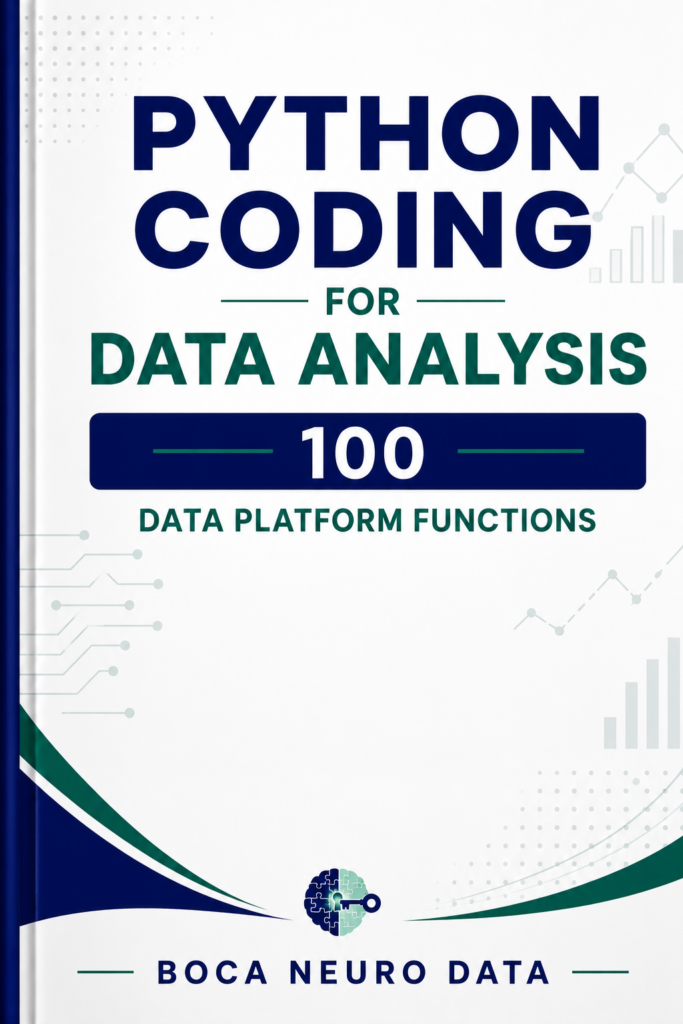
Available on Amazon Books from September 13th, 2026
Python Coding for Data Analysis: 100 Data Platform Functions is a practical and accessible guide designed for aspiring data analysts, data science students, business professionals, and anyone seeking to develop real-world Python skills for the modern workplace. Rather than focusing only on abstract programming theory, this book teaches Python through one hundred carefully selected functions and exercises that reflect the actual tasks analysts perform every day.
Readers will learn how to load, inspect, clean, transform, analyse, summarise, and automate data using powerful Python libraries such as Pandas. Each chapter is structured to reinforce understanding through practical examples, guided explanations, repetition exercises, and professional-style workflows. The book also emphasises how Python integrates with the evolving AI landscape, helping readers understand not only how to code, but why coding remains valuable in a world increasingly shaped by artificial intelligence.
From handling CSV files and missing data to generating reports and automating repetitive business tasks, this book provides a strong foundation for building confidence and technical fluency. Whether you are a beginner starting your first coding journey or an experienced professional seeking structured practice, this guide offers a clear and practical pathway toward becoming a capable modern data analyst.
The Strategic Advantage of Data
From a business perspective, the biggest missed opportunity in healthcare isn’t a lack of data—it’s how that data is used. Today, many organisations sit on vast amounts of information, yet much of it is trapped in silos. Clinical, operational, and financial data often exist separately, making it nearly impossible to see the full picture. In fact, studies suggest that up to 80% of healthcare data is underutilised—a striking inefficiency in such a data-rich environment.
When these silos are broken down, the impact is immediate. Suddenly, organisations can connect outcomes to operations and costs, revealing insights that were previously invisible. Imagine being able to link patient outcomes directly to workflow decisions or resource allocation—that’s where real value emerges.
Equally important is access. Data shouldn’t sit with a small group of specialists. When clinicians, analysts, and administrators can explore data themselves, decision-making accelerates. Teams move from static reports to real-time insight, enabling faster, more confident actions.
Ultimately, data only matters if it drives change. Organizations that integrate their data, open it up to their teams, and act on insights become more agile and effective. The message is simple: when data is connected and accessible, it stops being a by-product—and becomes a powerful driver of performance.

Single Patient View
After a few years working with data, one thing becomes obvious fast: healthcare doesn’t have a data problem—it has a connection problem. Information exists everywhere, but rarely in one place. You’ve got clinical records in one system, billing in another, operations somewhere else. It’s like trying to understand a story when every chapter is in a different book.
This is where technology is really felt. Using tools like SQL, Python, and cloud platforms, we can bring all that scattered data together. It’s like building a central hub where everything connects. Once that happens, things that were invisible suddenly become clear.
One of the most exciting outcomes is something called a single patient view. Instead of fragmented snapshots, you get one complete picture—history, treatments, outcomes, even financial interactions—all in one place. Everything switches from blurry images to high definition.
Standardizing data is just as important. When everyone is working with the same definitions and numbers, decisions become faster and more reliable. No more time lost debating which report is more acurate.
The real impact: Better insights, fewer errors, and faster action. When data is connected and easy to explore, it becomes a real driver of change.

AI & Neurology
Over the course of 2025 something shifted dramatically: AI went from a “nice-to-have” to a core driver of healthcare performance—especially in neurology. Since 2020, adoption has surged, with some estimates suggesting healthcare AI investment has grown by over 40%, accelerated by the pressures of COVID-19.
What’s changed most is decision-making. Neurology produces complex data—MRIs, EEGs, long patient histories—and AI can now connect the dots faster than ever. It’s not just about efficiency; it’s about outcomes. Predictive models can flag stroke risk earlier or identify subtle cognitive decline, enabling earlier intervention when it matters most.
But the impact isn’t just clinical. Hospitals are using real-time analytics to manage beds, staffing, and patient flow. Even small efficiency gains—say a 10–15% reduction in delays—can translate into significantly better patient outcomes.
There’s also a shift from reactive to proactive care. By analysing population-level data, providers can anticipate disease progression rather than respond to it.
The challenge is that much of the data (often over 70%) remains fragmented or unstructured. But as integration improves, the opportunity is clear: AI is completely redefining how healthcare operates.

Florida & Neuro Data: A Quantitive Perspective
One thing is clear: Florida represents one of the most strategically valuable environments for neurological data in the United States.
From a statistical standpoint, Florida represents a uniquely data-intensive environment for neurological analysis. Current demographic estimates indicate that more than 20% of the state’s population is aged 65 or older, compared to approximately 17% nationally. Given that age is the dominant risk factor for most neurological conditions—including Alzheimer’s disease, Parkinson’s disease, and cerebrovascular events—this demographic distribution implies a structurally higher baseline prevalence. Epidemiological data consistently show that incidence rates for these conditions increase exponentially with age, thereby amplifying the volume of observable clinical events within the state.
Empirical patterns of care utilization reinforce this conclusion. Florida exhibits high frequencies of neurological consultations and diagnostic procedures, including MRI, CT, and EEG. Each of these modalities generates high-dimensional data, encompassing both structured elements (e.g., coded diagnoses, laboratory values) and unstructured components (e.g., imaging data, narrative clinical documentation). The longitudinal accumulation of such data enables robust analytical approaches, including survival analysis, time-to-event modeling, and predictive risk stratification.
Despite near-ubiquitous adoption of electronic health records, the data landscape remains fragmented across providers and care settings. From a methodological perspective, this fragmentation introduces challenges related to data completeness, interoperability, and bias, thereby constraining statistical power and limiting external validity. However, it simultaneously presents a quantifiable opportunity: the integration of disparate datasets would enhance sample size, improve representativeness, and enable more precise estimation of treatment effects and disease trajectories.
In aggregate, Florida’s demographic profile, high clinical activity, and extensive—albeit siloed—data infrastructure position it as an optimal setting for advanced neurological analytics and evidence-based system optimization.
Is Python Coding an Obsolete Skill? Our Perspective
At Boca Neuro Data we do not believe that Python coding is a dead skill in the AI era. In fact, we believe the opposite is true: artificial intelligence has made Python even more important. While AI tools can now generate code automatically, they still depend heavily on human understanding, problem-solving ability, and technical judgement. The future does not belong to people who memorise syntax alone, but to those who understand how to use programming, data, and AI together to solve real-world problems.
Python remains one of the most widely used programming languages in the world because it is simple to read, easy to learn, and extremely flexible. It is used in data science, machine learning, automation, finance, cybersecurity, scientific research, and web development. Many of the most powerful AI technologies today are themselves built using Python libraries such as Pandas, NumPy, TensorFlow, PyTorch, and Scikit-learn. This means that AI is not replacing Python; instead, Python is helping power the AI revolution.
Many people argue that coding is becoming less valuable because AI can now generate scripts and programs in seconds. For example, a user can ask an AI assistant to write a data-cleaning script, build a dashboard, or generate SQL queries automatically. This is true to some extent. AI has reduced the time required for repetitive coding tasks and basic scripting. However, generating code is not the same as understanding it.
A major limitation of AI-generated code is that it is not always accurate or efficient. AI systems can produce errors, misunderstand instructions, create insecure solutions, or generate code that does not fit the business problem correctly. Someone still needs to review, test, debug, and improve the output. Without programming knowledge, a person may not even realise that the generated code contains mistakes. Because of this, coding skills continue to matter greatly.
I believe the value of programmers is shifting rather than disappearing. In the past, developers spent large amounts of time writing boilerplate code manually. Today, AI can assist with that process. As a result, the most valuable skill is no longer simple code memorisation. Instead, the most valuable skills are logical thinking, system design, data understanding, debugging, and the ability to ask the right questions. AI becomes a productivity tool for skilled developers rather than a replacement for them.
This is especially true in data science and data analysis. Businesses depend on data pipelines, automated reports, predictive models, and data cleaning workflows. Python is one of the most effective tools for handling these tasks. A data scientist must understand how data moves through systems, how to identify poor-quality data, how to automate repetitive tasks, and how to validate analytical results. AI can assist with these activities, but it cannot fully replace human judgement and domain expertise.
Another important point is that technology has always changed the nature of work. Calculators did not eliminate mathematics, and spreadsheets did not eliminate accountants. Instead, these tools allowed professionals to work faster and focus on higher-level thinking. AI is likely to have the same effect on programming.
In conclusion, Python coding is far from dead. The AI era is not eliminating programming skills; it is transforming them. Developers and analysts who combine Python knowledge with AI tools will likely become more productive, more adaptable, and more valuable in the modern workplace.